
How familiarity shapes what we notice and why attention sometimes begins with an irritation
What we see every day can quietly disappear from perception. This essay explores how familiarity shapes attention, why habit can hide possibilities in plain sight and how a small irritation can reopen the edge of what we notice.
Every morning, he walked through the same hall.
At first, he had still noticed the details: the dark stone floor, the two columns beside the reception desk, the tall plant in front of the glass wall, the quiet hum of the revolving door. After a few weeks, all of this had become a single path. Entrance, reception, columns, elevator. A movement that hardly needed a glance anymore.
This is how familiar spaces become walkable. They lose their individual parts and turn into a trace. The body knows where it has to go. The hand reaches for the card before thought has even registered the access point. The feet find the line across the floor. The eye only checks whether anything is disturbing the usual flow.
When a familiar space suddenly appears differently
One Tuesday morning, a grey barrier stood in front of the passage to the elevators. Behind it, the freshly mopped floor was shining. Two yellow warnings signs leaned against the wall at a slight angle. He stopped, a little too abruptly, as if someone had not blocked his way, but taken away his inner map for a moment.
A woman at reception looked up.
“You can use the side door.”
She pointed to the opposite wall.
He turned around.
Only then did he see it.
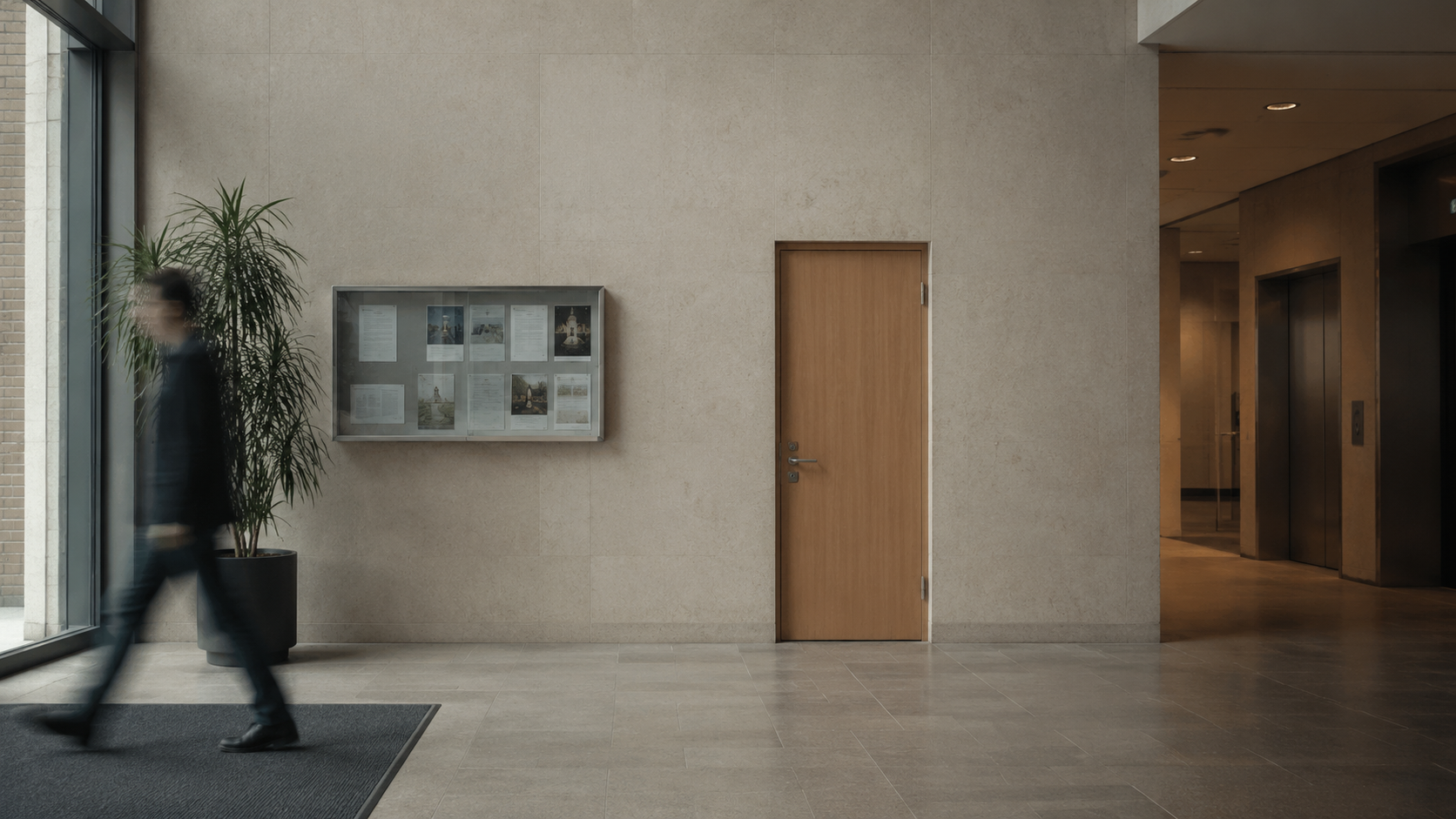
Between a display case and the tall plant was a narrow door. A green sign hung above it. The handle was polished, the frame slightly worn. Everything about it suggested that it was being used. Probably every day. Probably for years.
He had walked past it for months.
The door had not hidden itself. It had made no secret of its existence. It stood in the light of the hall, labelled, accessible, almost polite. Still, it had not appeared in his room. In the building he walked through every morning, this door existed. In the building he inhabited, it was missing.
It is a small experience. Perhaps too small to hold on to for long. You take the side door, find the new corridor, arive at your desk three minutes late and tell no one about it later. The day continues. The usual passgae is open again the next morning.
And yet, in moments like these, a precise question opens.
What do we actually see when we know a room?
Familiarity makes us capable of acting
We like to believe that familiarity makes the world more accessible. And it does. Without familiarity, we would have to examine every turn again, read every door, weigh every path. Everyday life would not hold. No organisation could work. No person could move through their own life if everything demanded the same degree of attention all the time.
Habit is form of mercy. It takes away the world’s constant demand. It turns countless details into a walkable order. Those who take the same route every morning do not have to invent it anew each day. Those who use a tool for a long time eventually feel its grip withoug looking at it. Those who live in a house find their way to the kitchen at night without switching on the light.
Familiarity relieves us. It makes us capable of acting.
This is precisely where its subtle power lies.
Every relief also helps decide what still needs to be noticed. It establishes paths that become self-evident. It orders rooms by use, people by expactation, processes by repetition. What works often enough no longer has to be seen. It becomes part of the background.
Over time, a building turns into a sequence of purposes: entrace, elevator, office, meeting room, exit. The wall between two paths loses its depth. The corridor becomes a connection. The door that is never used becomes a wall with a handle.
Organisations have doors like this too. Questions that were once asked and later became mere disturbances. Responsibilities that conceal a possibility. Rooms everyone knows and no one enters anymore. The fact that something exists does not yet mean it counts as access.
Many things do not disappear from the world. They disappear from the order through which we move in it.
Attention begins at the edge
This order is rarely conscoius. We do not carry it in front of us like a plan. It shows itself more often in what we no longer think about. In the paths we take. In the terms we use. In the people we ask. In the answers that seem plausible before we have examined them.
Attention begins deeper than many assume. It is not merely an intensification of the gaze. Someone who is attentive does not simply look harder at what is already at the center. Sometimes attention reveals itself when the edge gains contour again.
A side door.
An irritation.
A sentence that does not fit the usual sequence.
An object that has been moved.
A silence in a place where someone usually speaks at once.
These things are small. They do not interrupt the world. immediately. They only give it, for a moment, a different edge.
The temptation is to smooth out that edge as quickly as possible. The barrier is an inconvenience. The side door is a detour. The delay is an organisational problem. So the disturbance is fitted back into the old sequence as quickly as possible. The day, after all, continues to make its demands.
This is understandable. No one can turn every small deviation into an insight. Whoever reads a sign in every side door will eventually lose the path.
But sometimes it is worth lingering a moment longer.
The door does not have to become a symbol for that to happen. It is enough to notice, through it, how quickly we neutralize something that touches our inner plan. The irritation does not first show what is different. It shows how strong the previous order was.
The man in the hall had not overlooked the door because his eyes were failing him. He had overlooked it because his path worked. The usual passage was so reliable that the alternative faded into background. Only the blockage gave the door a new meaning. It turned a structural element into a possibility.
Perhaps this is one of the quieter forms of attention. Noticing when something moves from the background into the foreground.
Spaces distribute possibilities
This sounds simpler than it is. The background is not empty. It consists of decisions, habits, roles, responsibilities and small orders of power. Who is allowed to use which door? Who knows it is open? Who was never told about it? For whom is it too narrow, too heavy, too hidden, too risky? Who has learned that certain rooms may exist, but are not meant for them?
An overlooked door is therefore never merely a private matter of perception. Spaces distribute possibilities. Sometimes through walls, sometimes through labels, often through habit. What is a side entrance for one person may be the only access for another. What remains a marginal issue for an organisation may be the actual threshold for those affected by it.
This is why attention falls short when it is understood only as personal alertness. It always has a social side as well. It asks how a room is arranged, who moves through it as matter of course, and who becomes visible only after a detour.
In the hall, this question was hardly dramatic. The side door led into a narrow corridor, past a copier, a cloakroom and a windows facing the inner courtyard. After a few meters, a second door opened back into the main corridor behind the elevators. No secret room, no hidden truth. Just another way through the same building.
That was exactly what made the experience so precise.
The new path did not change the building. It changed its walkability. The man not knew something that had already been true before, but had not yet taken shape within him.
A new line on the inner map
The next morning, the floor was dry, the barrier gone, the usual passage open. Most people walked straight ahead as always.
He, too, first moved toward the elevators.
Just before the columns, he turned his head. The side door was still there. Now it belonged to the room.
Perhaps change sometimes begins as unspectabularly as this: a possibility becomes visible without insisting on itself. A familiar order reminas in place, but it is no longer quite as closed. The inner map has gained a new line.
On could walk past it. One could forget it again. One could keep to the usual path and still know that another connection exists.
This knowledge is small. It does not yet oblige anyone to do anything. It carries no grand gesture. But it changes the way one enters the room.
Many thresholds emerge in this way. Long before someone makes a decision, the gaze has shifted. Long before a new path is taken, the old one has lost its self-evidence. Long before a door is opened, it first appears again as a door.
In Archimetis, this exact moment matters. The moment in which a familiar order receives a crack and the gaze does not yet know what to do with it.
At this threshold, a parable from the Archimetis thought space begins. It tells of Clara, of a familiar building, and of a door that had not disappeared. It had only ceased to be part of the visible world.
This parable bears the title:
The Door You Forgot.
What this essay is about
This essay opens a line of thought within Archimetis: attention begins where a familiar space loses some of its self-evidence. At its center is the question of how familiarity shapes perception, how habit can conceal possibilities and why small irritations sometimes draw a new line on our inner map.
The central movement of the essay:
- Familiarity makes spaces walkable
- Habit relieves perception and narrows it at the same time
- Attention often begins at the edge of the known
- Overlooked doors reveal which possibilities no longer count as access
- Spaces distribute visibility, responsibility and movement
- The parable The Door You Forgot begins at this threshold
Questions this essay opens
Which possibilities remain visible, yet no longer appear in our everyday perception?
When does habit help us move and when does it make our field of vision too narrow?
Which doors do we know without still experiencing them as access?
Who moves through a space as a matter of course and who becomes visible only after a detour?
How does attention change when the edge begins to gain contour again?