
A Space for Awareness, Organisations and Change
What is Archimetis?
Sometimes the decisive tension appears in a meeting. A model lies neatly on the table, all terms seem clarified and yet it remains perceptible that the situation itself has not been understood.
Organisations are constantly beeing built: processes, roles, target pcitures, systems, roadmaps. Far less attention is given to the ways of seeing from which these structures emerge. This is where Archimetis begins.
This question arose from my work in enterprise architecture. The more closely I examined models, processes and vision of a future state, the more clearly I began to notice orders that no representation could fully capture. These were, for example, expectations, habits, power relations, pressures of time and tacit assumptions about what was allowed to count as a problem in the first place.
Archimetis is a space for exploring the architecture of thought. It asks how perception, order and decision shape one another and how organisations influence what people notice, overlook, consider possible and eventually do.
The name brings together two movements. The architectural work of shaping structures, spaces and transitions. As well as Metis, the intelligence that perceives, weighs and remains capable of action under uncertain conditions.
Archimetis explores the threshold between model and perception as well as between external structure and inner insight. Wherever structures take shape, they also reveal a particular way of seeing.
This space is intended for people who carry responsibility within organisations. To leaders, architects, advisors, practitioners of change and attentive observers of organisational life. It speaks to those who sense that many transformations begin at the visible surface while their deeper work unfolds in thought.
Three Ways into Archimetis
Archimetis explores the architecture of thought through three interwoven ways of entry: awareness, organisation and change. They open fields in which it becomes visible how people and organisations perceive, create order and remain capable of action.
Awareness
How do we perceive what is happening in and around us? Which inner images guide our decisions long before we can put them into words?
Archimetis regards thought as an open workshop which is visible enough to be worked on and unfinished enough to remain responsive.
Awareness also involves the capacitry to bring the conditions of our own seeing into view. Which experiences shape our interpretations? What acquires significance? Which assumptions have become so self-evident that they are barely noticed?
Organisation
An organisation rarely exists only where it has been drawn. It becomes visible in responsibilities, routines, expectations, unspoken rules and the paths along which attention is directed.
Such orders distribute visibility, influence and burdens. They help determine who is heard, who carries responsibility and whose experience remains in shadow.
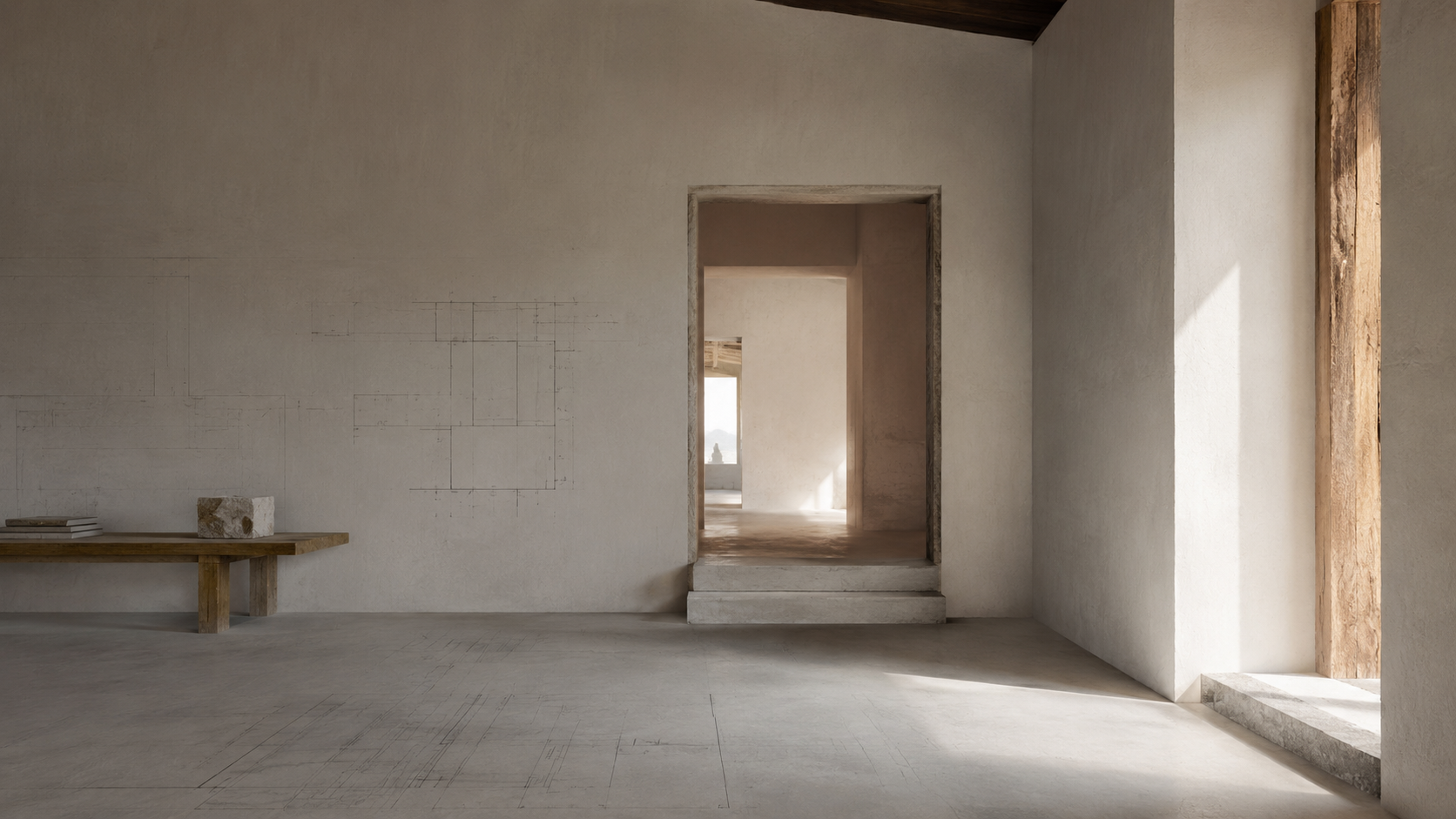
Archimetis asks how structures can remain stable without becoming rigid. Enterprise architecture then becomes work on the underlying floor plan of thought. It shapes systems, perspectives, transitions and the space in which decisions become possible.
Change
Change rarely begins where the project plan places it. It moves through habits, images, expectations and meanings.
Here, change appears as a passage between conditions. Some structures still hold. Others have lost their form. Something new may already be perceptible while remaining difficult to enter. Archimetis looks for the moments in which such movements become visible.
Constellations within Archimetis
Five constellations recur throughout the work of Archimetis: attention, Metis, unfinishedness, coherence and time architecture.
Each brings a different tension into view. Visibility and shadow, situational intelligence, the productive openness of unfinished, sustaining coherence and the rhythms, perios of maturation and interruptions the enable or obstruct action.
Attention asks what becomes visible and what remains outside the field of vision. Metis points towards an intelligence that moves with a situation without becoming arbitrary. Unfinishedness keeps development open where premature closure would narrow its possibilities. Coherence seeks a viable sense of connection without smoothing over difference and conflict. Time architecture examines how rhythms, deadlines, duration and simultaneity shape thought and action.
Gradually, a floor plan emerges. It resembles a workshop rather than a completed building. Open enough for new observations, yet stable enough to support further work.
How Archimetis Takes Form
Archimetis grows through every observation, every text and every question. Its unfinished character is deliberate.
This openness calls for clarity and judgement. It keeps questions in motion where premature closure would restrict the view and it leads towards decision when a situation requires one.
Not every observation becomes a text. What matters is whether it opens a situation, makes an order visible or sharpens a question.
Essays, parables, models and dialogue give Archimetis provisional forms. They preserve observations, test concepts and male connections visible that often resist purely explanatory language.
The inquiry frequently begins in practice. It does not stop there. Observations are examined conceptually, connected with other perspectives and held open until their underlying order becomes clearer.
- Blog, Essays & Parables
Essays and observations form the working life of an enterprise architect. They follow the small scenes in which it becomes visible how organisations perceive, create order and decide.
Some texts examine these orders conceptually. Others enter a story in which their tensions can be experienced. Parables give form to observations whose meaning can be captured only partially through models and explanations.
Go to the blog - Concepts & Models
Concepts, images and models in development. They are meant to make concrete situations more legible, such as blind spots, transitions, tensions, load-bearing strcutures and the areas of uncertainty in which change often begins.
Models provide orientation. Their edges remain visible, because this is often where the design reveals what it has not yet captured.
Explore topics - Dialogue & Collaboration
Formats, guidance and shared inquiry can emerge where a question has become mature enough to work on while remaining open enough to resist a premature answer.
Get in touch
About Archimetis and the Person behind It
Archimetis emerges from my work as an enterprise architect. In this work, I encounter models that provide orientation and realities that repeatedly elude them. Orgsnisations often become most revealing within this gap.
I write from a position of involvement. I experience how decisions are prepared, structures negotiated, contradictions smoothed over and responsibilities distributed. I have become increasingly interested in the unseen order beneath visible architectures. The assumptions that direct attention, the experiences that find no place in the model and the possibilities that a particular way of thinking opens or closes.
Many models become especially revealing at their edges. This is where experiences, conflicts, dependencies and consequences appear that found no place in the clean design.
Some observations exceed the reach of a model. They need a figure, a landscape or a situation in which their underlying oder can emerge. This is why parables also belong to the workshop of Archimetis.
Archimetis brings together the ordering work of architecture and the agile intelligence of Metis. Its texts are working pieces within an ongoing inquiry, shaped by practice, conceptual work and a willingness to question even one’s own designs.
On the Architecture of Thought in Organisations
The introductory essay traces the origins of Archimetis, explores the role of Metis and considers unfinishedness as a form of thinking and working. It opens the first floor plan of this space and follows the question of what happens when architecture also shapes perception, meaning and decision.
Read the introductory essay: Archimetis – Architecture of Thought
Work on the architecture of thought often begins where a familiar explanation loses its self-evidence.
Recent Essays from Archimetis
- Attention Begins Before Focus – What Shapes Visibility
- I Draw Pictures and Talk to People
- Architecture of Attention – Why Organisations Work on the Wrong Things
- The Door in the Familiar Room
- Unfinishedness as a Method – Why Early States Are Powerful