
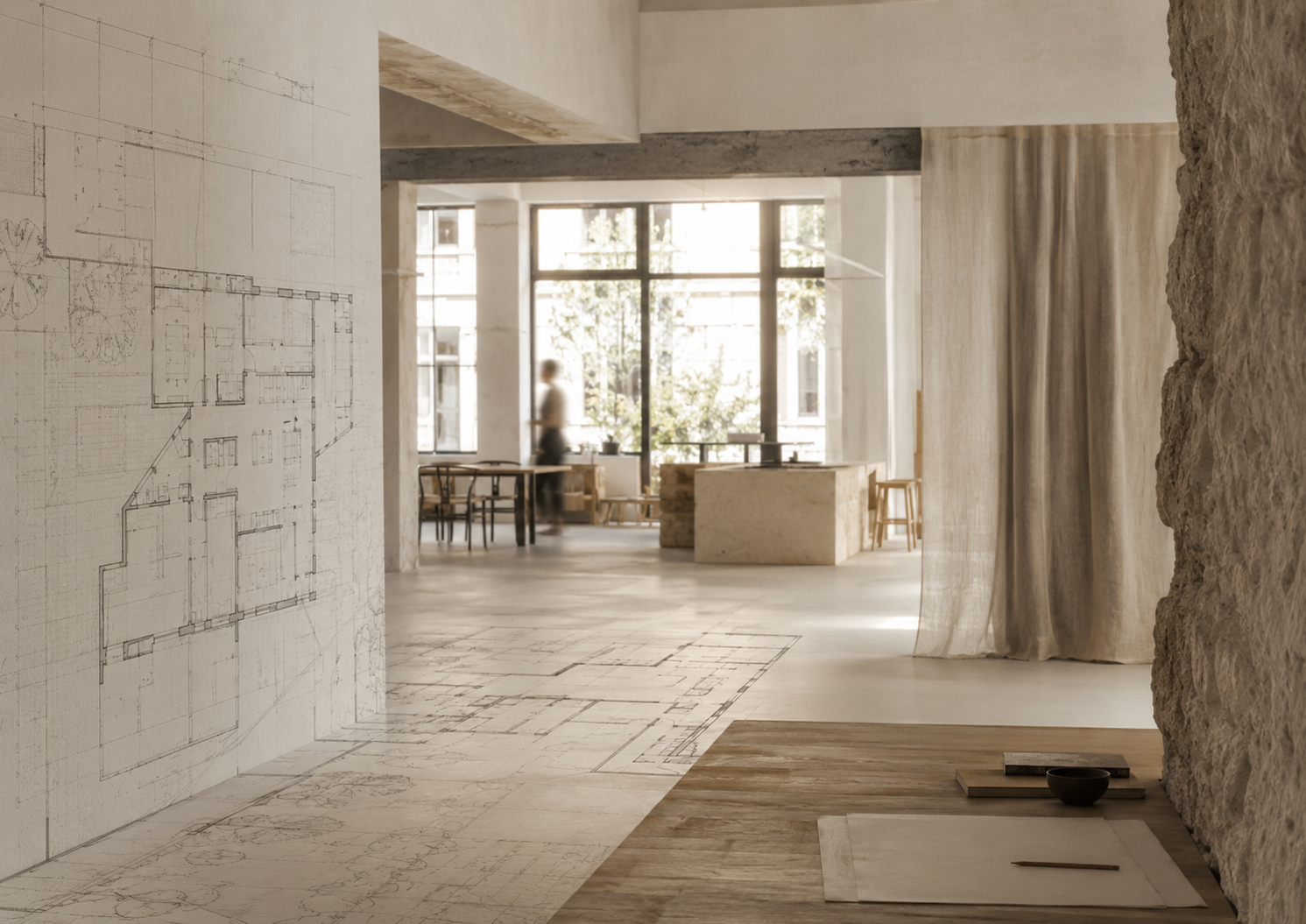
How an Unease in Enterprise Architecture Became a Space for Consciousness, Organisation and Change
Archimetis grew out of a recurring unease in my work with organisations that an organisation can appear complete on slides and still follow a different order in everyday practice. Processes, roles and systems only reveal part of their reality. Decisions are also shaped by experience, relationships, tacit rules, power relations and habitual patterns of attention.
The name Archimetis brings together two movements. Architecture stands for order, structure and deliberate design. Metis denotes an adaptive form of practical wisdom that notices change and remains capable of action under incomplete conditions. Their conjunction opens the question of the architecture of thought as the often unnoticed order of attention, assumptions and temporal patterns from which models, decisions and organisations emerge.
This article traces the origins of Archimetis and describes the space for thought that has grown from them. Its constellations, named attention, metis, unfinishedness, coherence and time architecture, offer different perspectives on the same question: How do orders emerge that can hold and when do they begin to narrow our view?
In brief
Archimetis is a space for thought concerned with consciousness, organisation and change. It examines how attention, assumptions, power relations and temporal patterns shape the orders from which organisations act, decide and transform. The architecture of thought refers to the often unnoticed order that precedes visible structures, models and decisions.
An Organisation That Was Complete on the Slide
On the screen, the organisation was complete.
Departments, processes, applications and dependencies were arranged in a clean model before me. Every line had a meaning and every element had its place. The representation had grown over many months. It was aligned, comprehensible and almost reassuring.
The next conversation, however, revealed a different organisation.
A decision had been travelling between two departments for weeks. A handover that looked unambiguous in the model depended on an employee who knew whom to call when uncertainty arose. A process worked because several people supplemented its formal rules with their experience. A responsibility that had officially been clarified remained unattended as soon as the situation departed from the expected routine.
None of this appeared on the slide.
I was working as an enterprise architect. My task was to make relationships visible, bring order to structures and design possible futures. Yet the more precise the models became, the more clearly I began to see their edges. Behind the connections we had drawn lay a second order which was less visible, rarely documented and still deeply effective.
It appeared in whom people trusted. In the questions they avoided. In the moments when they assumed responsibility although no process required them to do so. In the decision that had to wait until a particular person returned to the room and in the experience that carried more weight than the official rules.
A gap had opened between the drawn plan and the organisation as it was lived.
From that gap came a question that has stayed with me ever since:
What are we shaping when we shape an organisation?
The Gap Between the Drawn Plan and the Lived Space
Models are necessary. Without them, complex organisations would be almost impossible to view together. They reduce complexity, create order and give conversations a shared object.
Every representation, however, rests on a selection. It shows what was considered relevant. It draws boundaries, distinguishes inside from outside, names certain elements and leaves others in shadow. A model therefore carries traces of the attention from which it emerged. The selection itself often goes unnoticed.
A model also carries traces of power. Who decides which distinctions count? Whose language becomes the official description of a situation? Which experience enters the model and which is treated as deviation, resistance or disruption? Such questions rarely appear beside the boxes and connecting lines. Their effects nonetheless reach deep into the order being represented.
An organisational chart shows lines of responsibility, though rarely the actual paths of trust. A process diagram describes the intended sequence while daily work is held together by exceptions, questions and tacit agreements. A strategy names its goals without always revealing the image of reality embedded within them or who will carry the consequences of their implementation.
The difficulty begins when the representation is mistaken for the organisation itself. A responsibility that has been modelled cleanly is then assumed to have been clarified. An approved process is treated as lived practice. A shared target picture becomes evidence of a shared understanding. The map begins to cover the space it was once meant to make legible.
Archimetis began at this point.
The initial unease was directed neither at models nor at architecture. It concerned the quiet certainty that an organisation had been sufficiently understood once its visible structures had been described.
Yet organisations are also made of expectations, memories and recurring interpretations. They develop habits of seeing. Some deviations attract immediate attention, while others remain unnoticed for years. Certain questions are given room, others fall silent at the organisation’s thresholds.
What an organisation perceives shapes which reality becomes available for it to work on.
Before an organisation builds structures, it organises attention.
Where the Name Archimetis Comes From
Archimetis is a coined word. The name brings together two movements that may at first appear far apart.
Architecture stands for order, structure and design. It asks how parts relate, which transitions a space requires and what weight a construction must be able to carry. Good architecture makes movement possible. It provides support without prescribing every step.
Architecture is therefore never innocent. A door provides access and can exclude others. A wall protects and separates. A floor plan distributes proximity, visibility and influence. Organisational architecture likewise shapes who encounters whom, where decisions emerge and which routes become long or short.
Metis leads towards a different kind of intelligence. In Greek tradition, metis is associated with practical wisdom, foresight and the capacity to respond to changing circumstances. This intelligence does not follow a rigid plan. It reads the situation, recognises the opportune moment and alters its course when conditions demand it.
Metis appears in the workshop of action. An experienced doctor notices that a familiar symptom carries a different meaning this time. A navigator detects a change in the wind before it registers clearly on the instruments. A leader senses that a formally sound decision would not reach the people in the room at that particular moment.
This form of wisdom is no groundless act of spontaneous improvisation. It condenses experience, attention, judgement and a sensitivity to the particular nature of a situation.
Architecture creates continuity. Metis preserves mobility.
Archimetis brings both into a shared field of tension. The name points towards an order that remains aware of its own provisional nature. A structure capable of responding to change. A plan that provides orientation while keeping its blind spots in view.
From this conjunction emerged the guiding idea of an architecture of thought.
The Architecture of Thought
Architecture of thought is the often unnoticed order of attention, distinctions, assumptions and time patterns from which decisions, models and organisations emerge.
It takes shape before an organisational chart or process map appears. It is present in the language an organisation uses, in the distinctions it takes for granted, in the time it gives to certain questions and in the experiences it allows to become relevant.
People first decide what they consider significant. They give things names, create categories, draw boundaries and place events within a story. Some experiences become metrics. Others remain anecdotes. Certain contradictions lead to change, while habits of overlooking gradually form around others.
Visible structures later grow from these earlier acts of ordering.
An organisation that pays close attention to error will build different processes from one that treats deviation as a trace of learning. Someone who understands change as a sequence of predictable steps will design different transitions from someone who expects feedback loops and periods of uncertainty. Where efficiency becomes the dominant lens, pauses, detours and apparently redundant relationships soon look expendable.
Every formal architecture bears traces of such prior decisions.
Since then, I no longer view an architecture model as a neutral representation. It also reveals what an organisation considers relevant, where it draws its boundaries and which parts of reality become indistinct at the edges.
The architecture of thought is located neither solely within individual minds nor exclusively within formal structures. It forms between them in language, routines, meetings, decision paths. It is also shaped by software, physical spaces and material conditions. Time pressure, exhaustion, bodily presence and the absence of particular people alter what an organisation is able to see and decide.
Thinking therefore extends beyond the interior of the mind. It takes form in the conditions under which people encounter one another, perceive information and assume responsibility.
The architecture of thought is no hidden floor beneath the actual organisation. It is the order from which the organisation’s visible spaces arise.
A Space for Thought Before Method
Organisations work with methods, models and frameworks because they cannot answer every recurring question from the beginning. These forms preserve experiences. They establish a common vocabulary and make coordination easier.
Archimetis begins one step earlier.
It asks which perception gave rise to a method. Which assumptions support it? What kind of situation does it make visible? Under which conditions does it lose its capacity to hold? What remains outside its field of view? Who gains room for action through the order it creates and who is required to adapt to it?
Much like a map, a framework can guide an organisation through familiar terrain. A space for thought becomes important when the terrain changes or the available map fails to show the decisive passage.
Archimetis therefore offers no universal sequence for arriving at correct decisions. It directs attention towards the moment in which an order becomes self-evident. That is where the work on its foundations begins.
At times, this means reopening a question that appeared to have been settled.
Is a delayed decision really caused by unclear responsibility? Or do the people involved lack a shared understanding of the situation? Is a process slow because its steps are poorly designed? Perhaps it is carrying contradictory expectations that have never been given a place to surface. Does a change initiative need greater speed? It may first need a threshold across which people can leave a familiar order without having their previous experience devalued.
At such points, the space for thought slows the rush towards intervention. This slowing creates the possibility of acting with greater precision. It protects an organisation from solutions that merely reinforce the perspective from which the problem arose.
Archimetis asks before it orders.
The question does not delay action. It belongs to the responsibility of acting.
The Open Blueprint
The first Archimetis text emerged during a deliberately open phase. Many concepts initially existed only as traces. Thoughts stood alongside one another without yet forming a closed structure.
This unfinishedness became a question in its own right.
Organisations often demand clarity early. Ideas receive names, owners and deadlines before their contours can be recognised. A preliminary draft turns into a binding solution because its provisional status disappears during the course of alignment. A working hypothesis hardens into a wall.
Archimetis understands unfinishedness as framed provisionality.
An open blueprint has a structure. It also indicates which parts can be moved later. Openness requires form, otherwise it dissolves into arbitrariness. Form requires mobility, otherwise it becomes premature fixation.
This attitude also shapes the space of Archimetis itself.
Its concepts should be able to carry weight without withdrawing from change. Models may create clarity while remaining open to examination. A thought can be developed far enough to work with even while its edges remain visibly unfinished.
In this sense, unfinishedness means the capacity for revision.
It preserves an opening for experiences that the original design could not yet anticipate.
Five Perspectives on Organisation and Change
Five constellations have emerged from the original unease. They do not form a methodological sequence but rather lead into the architecture of thought. Each opens a different view of how people and organisations see, order, decide and remain capable of action.
The five constellations of Archimetis
Attention asks what becomes visible and what remains in shadow.
Metis asks how situational intelligence enables action under incomplete conditions.
Unfinishedness asks how provisional forms can remain both workable and open to experience.
Coherence asks what creates connection, orientation and inner stability without erasing tension.
Time Architecture asks which rhythms, interruptions and thresholfs make change possible or prevent it.
Attention
Attention asks what comes into view and what remains in shadow. It means more than concentration or focus. Organisations distribute visibility through goals, metrics, roles, calendars and language. In doing so, they also shape which experiences count as relevant to decision-making.
The constellation of attention examines these conditions of seeing. It asks who frames a situation, which signals are given weight and how an organisation recognises that its field of vision has become too narrow.
Metis
Metis focuses on the capacity to act in changing conditions. It is neither mere improvisation nor the opposite of planning. Metis becomes significant when a plan encounters a changed reality and judgement has to reconnect the two.
The constellation asks how organisations can act with situational intelligence when knowledge remains incomplete and the situation still demands a decision.
Unfinishedness
Unfinishedness examines the space between an initial form and final determination. It does not stand for arbitrariness. Its quality becomes visible when the provisional is framed firmly enough to support collective work and openly enough to be changed by experience.
Some initiatives lose their mobility because they begin to appear finished too early. Others remain without consequence because no one assumes responsibility for their next form.
Coherence
Coherence asks what holds difference together. It is not harmony and does not require an organisation free of contradiction. A durable form of coherence allows tensions to remain visible while still providing orientation.
The constellation focuses on the relationship between language, action and lived meaning. Where this connection becomes brittle, parallel realities emerge. One officially applies while something else sustains everyday practice.
Time Architecture
Time architecture examines the rhythms, deadlines and transitions of action. Calendars and planning cycles shape what is allowed to mature, what is interrupted and which parts of the past continue to reach into the present.
Time is no neutral container. Its design distributes attention, creates pressure and helps determine which forms of development an organisation is capable of perceiving.
These constellations offer different perspectives within the same space for thought. They explore how people and organisations see, order and decide – and how they remain capable of action under contradictory or changing conditions.
What Archimetis Works On
Archimetis follows the places where an organisation’s visible order begins to crack.
Some texts start with an observation from working life. A decision that cannot find a place despite clearly assigned responsibility. A target picture that looks complete and still fails to create a shared direction. A process whose detours reveal more about the organisation than its intended sequence.
Writing carries these observations further. It gives them order without smoothing them too quickly. It tests concepts against experience and searches for language for connections that often appear in models only at the margins or as deviations. In this sense, writing itself is a form of architectural work. It reveals transitions, shifts boundaries and shows which structure allows a thought to hold.
Some texts develop concepts and connect them with research, theory and practical experience. Others take the form of a parable.
A parable does not explain a situation from the outside. It allows us to enter it. People step into a space, reach a threshold or have to act before the full order becomes visible. What may appear abstract in conceptual language acquires time, resistance and consequences.
Essays, models and parables follow different paths. They work on the same subject: the unnoticed orders through which people and organisations see, decide and remain capable of action.
The view moves between models and lived practice, formal structure and the transitions at which people assume responsibility, lose influence or are excluded by an existing order.
The question of power remains present throughout. Who is permitted to describe a situation? Who decides when a problem counts as solved? Whose knowledge becomes formalised and who must carry the consequences of a decision in everyday life? An architecture of thought that ignored such questions would reproduce its own shadow spaces.
Models, methods and forms of work may emerge from Archimetis. They remain instruments of thought. Their value lies in whether they allow a situation to be seen more clearly and enable responsible action without closing it too soon.
Such a shift in perspective does not transform an organisation by itself. It may, however, reveal that a conflict arises from two incompatible understandings of time, that a stalled transformation carries a problem of attention or that an apparent detour points towards a form of intelligence for which the official process has no name.
At times, it also becomes clear that an existing order works quite well, though at the expense of those whose additional labour, dependency or exhaustion never appears in the model.
Change often begins when a familiar situation becomes readable in a different way.
Where the Path Continues
I still draw lines.
I continue to work with structures, models and target pictures. The difference is that I no longer regard these lines as neutral. Every connection brings something into focus. Every boundary creates an inside and an outside. And every order carries the history of the attention from which it emerged.
This makes architecture a matter of responsibility.
Architecture begins earlier than the plan. It begins in the language an organisation uses to describe its situation. In the questions for which it makes time. In the distinctions it takes for granted. In the experiences to which it gives meaning – and those over which its gaze passes.
Archimetis follows these early traces.
It begins where attention becomes order. Where order acquires a structure. And where enough movement remains to examine a direction.
Architecture begins with insight.
That is where Archimetis begins.
Continue Thinking with Archimetis
- The Architecture of Attention – How Organisations See and What Escapes Their View
- Metis – On Practical Intelligence in Times of Change
- Unfinishedness as a Method – Why Early States Hold Creative Power
- Organising the Soul – Coherence as an Inner Structure (Article in preparation. Link follows)
- Time Architecture – How Rhythms, Transitions and the Debris of Time Shape Organisations (Articlel in preparation. Link follows)